
Updated pricing for usage-based credits
The problem with a flat price
Since launch, every run on a given model has cost a fixed number of credits. Gemini Flash was 20 credits a run and Claude Opus was 100, whatever the run did. A flat price is easy to read, and we liked that about it. But the cost of a model call is not flat, and the gap between the two has kept widening.
- Models differ by a hundred times. The fastest models cost a fraction of a cent for a reply. The largest cost several cents for the same reply. One price scale cannot be fair to both ends.
- Length matters more than the model. A model reads the whole conversation again on every turn, plus every document attached to it. A ten-turn chat with a 100-page PDF can cost more than a hundred one-line questions on the same model.
- Agents make many calls per run. One Agent turn can call the model several times as it uses tools, and reasoning models think before they answer. None of that showed up in a flat price.
- Prices keep moving. Providers cut prices, add tiers, and retire models every few weeks. A flat catalog is out of date the day we set it.
To keep a flat price safe, we had to set it near the expensive end of each model. That meant most runs, the short ones, were paying for the few big ones. The same 20 credits covered a quick question that used a small fraction of them and a document review that used more than double. Big documents felt free while quick questions felt expensive, and neither was right.
The fix: credits that follow usage
Each model call is now priced from the tokens it read and wrote, at that model's own rate, and a run charges the sum of its calls. A short reply costs a fraction of a credit. A long, document-heavy conversation costs what it uses. A ten-turn Agent loop on a premium model no longer costs the same as one quick question, and when a provider cuts its price, your credits go further the same day.
What changes for your bill
We took a random sample of conversations from across the platform and re-priced every model call in it under the new rules. About nine in ten calls came out cheaper, and the sample's total came to less than half of what the flat prices charged. The calls that cost more are the very long ones on premium models, which the flat prices quietly subsidized.
Here is that sample. Hover a dot to see what it costs now.
One dot per model call from a random sample of conversations across the platform, priced under the new rule. Dots left of the line cost less than that model's old flat price. Models with too few calls in the sample are left out.
For a typical reply, about 1,500 words of prompt and context in and 300 words out, at current list prices:
| Model | Before | Now |
|---|---|---|
| Gemini 3.7 Flash | 20 credits | about 1.7 credits |
| Claude Sonnet 5 | 20 credits | about 3.7 credits |
| GPT-4o | 15 credits | about 3.9 credits |
| Claude Opus 5 | 100 credits | about 6.7 credits |
The same conversation with a large document attached lands higher, because the model reads every page of it on every turn. Attach what the reply needs and the credits follow.
How far 10,000 credits go
The clearest way to see the change is in messages. Take the Agency plan's 10,000 monthly credits and divide by what an average message costs on each model, using the average message in that same sample rather than a best case.
| Model | Messages before | Messages now |
|---|---|---|
| GPT-4o Mini | 2,000 | about 50,000 |
| Gemini 2.5 Flash | 500 | about 8,800 |
| FormWise Instant | 1,000 | about 2,000 |
| GPT-4o | 667 | about 2,600 |
| Claude Opus 4.6 | 100 | about 560 |
Even the heavy sessions, the long conversations in the top tenth of the sample, still get more messages out of the same allowance on these models than the flat prices allowed.
Cost tiers in every model picker
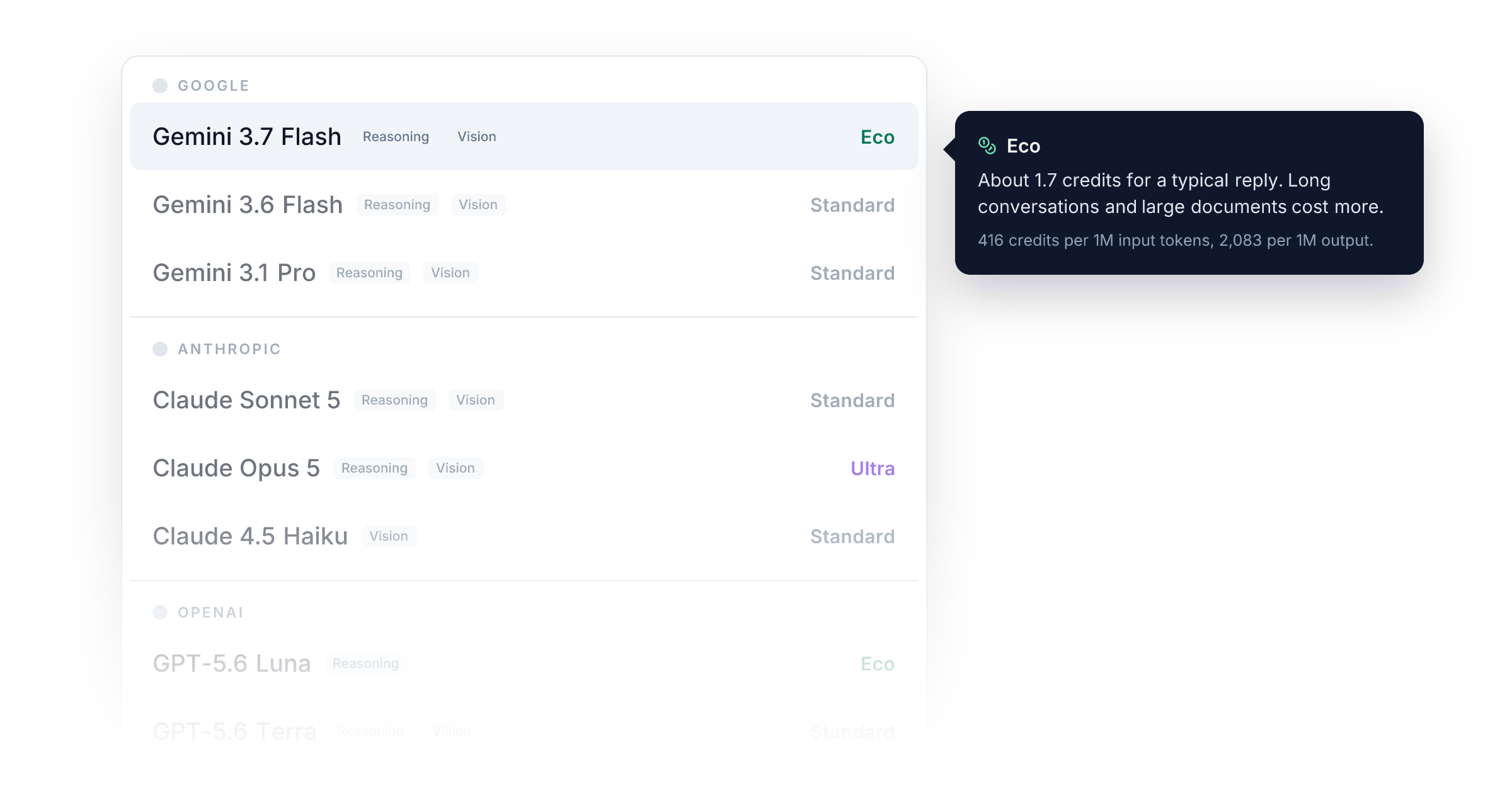
Rather than ask you to think in tokens, every model picker now labels each model with a cost tier: Eco, Standard, Performance, or Ultra. The tier comes from what a typical reply costs on that model. Hover the tier to see the number behind it, along with the model's rate per million tokens for people who want the detail.
Flash and mini models land in Eco. Haiku, the Sonnet models, and the mid-size GPT models land in Standard. Opus and GPT-5.5 land in Performance. Ultra is reserved for the largest frontier models.
What stays the same
- A credit is still a credit. Plan allowances, credit packs, bonus credits, and the on-demand rate are unchanged.
- Built-in actions keep their flat prices: web search, page scraping, image generation, and Knowledgebase search cost what they did before.
- Runs on your own provider key still consume no credits.
- Portal end users are metered the same way, so the credits in their plans go further too.
Usage now shows decimals wherever credits appear, on the Billing page, in Suite usage, and in analytics, so a run that cost 0.71 credits reads as 0.71 rather than rounding to zero or one.
What this means for Plans and Portals
Credits in the plans you sell through a Portal are metered the same way, so subscribers get more from the same allowance.
Setting that allowance is no longer a guess. Because a credit now maps to a fixed amount of work, the plan editor can tell you exactly what an allowance costs you if a subscriber uses all of it, and how many typical replies it buys, so you can size a plan to how your customers actually use it. The same estimate appears for free plans and credit packs.
FormWise Classic is not affected
This change applies to the new FormWise platform only. FormWise Classic runs on its own billing system, and if you use Classic your metering and billing stay exactly as they are today, with the same flat credit prices per run.
Improvements
- Billing: The Billing page, Suite usage cards, and analytics show fractional credits instead of rounding to whole numbers.
- Model pickers: Every picker shows the model's cost tier, with a tooltip giving credits for a typical reply and the rate per million tokens.
- Runs: A run that stops partway charges only the model work already done.